The Origins of Halloween in America: What History Tells Us
If Halloween feels like a holiday that was invented in America, the real story may surprise you. Halloween history America is a story of migration, cultural exchange, changing beliefs, and generations of reinvention. The holiday did not arrive as one complete tradition. Instead, customs connected to Samhain, Christian observances, European folklore, Irish and Scottish immigration, and American community life gradually came together. From early harvest gatherings and neighborhood mischief to costumes, trick-or-treating, and decorated homes, American Halloween became something uniquely its own.

Halloween Began Long Before It Reached America
To understand the origins of Halloween in America, it helps to travel back more than a thousand years before the United States existed. Halloween's deepest historical roots are commonly connected to Samhain, a Celtic seasonal festival associated with the end of harvest and the beginning of winter. The Library of Congress identifies Samhain as an ancient pre-Christian Celtic festival of the dead and notes that Halloween later developed through Celtic and Catholic influences.
However, this history deserves some caution. Popular Halloween stories often present ancient Samhain customs as if every modern detail can be traced directly to one ancient ritual. Historians do not have complete evidence for exactly how the earliest celebrations worked. Smithsonian emphasizes that many popular descriptions of Samhain remain part history and part later tradition or folklore.
What is clearer is the broad cultural pathway. Seasonal festivals, beliefs about supernatural beings, Christian observances surrounding All Saints' and All Souls' Days, disguising customs, and later European folk practices all contributed pieces to the Halloween tradition.
What Was Samhain?
Samhain marked the transition from the lighter half of the year into the darker season. Traditional accounts associate the period with the dead and supernatural beings, while historical evidence confirms that Samhain was an important seasonal observance in the Celtic world.
According to Smithsonian, the first historical record of Samhain appears on the Coligny Calendar, a bronze calendar dating to the 1st century B.C.E.
That does not mean modern Halloween existed at the time. Instead, Samhain represents one important ancestor in the much longer story.
How Did Samhain Become Halloween?
Christian traditions gradually became intertwined with older seasonal customs. All Saints' Day was established on November 1, making the evening before it All Hallows' Eve, a name that eventually shortened to Halloween.
Over centuries, European communities blended religious observances, folk beliefs, seasonal customs, storytelling, and social traditions.
By the time Halloween crossed the Atlantic, it was already carrying centuries of cultural history.
How Halloween Came to America
Halloween was not immediately a major American holiday. In colonial America, celebrations varied significantly by region and religious community. HISTORY notes that Halloween was particularly limited in colonial New England because of strong Protestant traditions, while it was more commonly recognized in Maryland and some southern colonies.
This regional difference matters because it shows that there was no single “first American Halloween.” The holiday developed unevenly, then gradually spread as different communities interacted.
During the 18th and 19th centuries, European immigrants brought their own seasonal customs with them. Irish and Scottish traditions became particularly important. The Library of Congress documents the enormous scale of Irish immigration, including approximately 4.5 million Irish arrivals in the United States between 1820 and 1930, with particularly large numbers arriving around the Great Famine.
Those immigrants did not simply reproduce Halloween exactly as it had existed in Europe. Their traditions encountered American customs and gradually changed.
Why Irish Immigration Mattered
The Irish Potato Famine beginning in 1845 accelerated a major wave of Irish immigration to the United States. The Library of Congress records that about one million people died in Ireland during the famine while roughly half a million arrived in America within five years.
Along with families and possessions came language, food, stories, beliefs, and seasonal customs.
Halloween was one of those traditions.
Smithsonian notes that Halloween properly reached the United States with the mass arrival of Irish and Scottish immigrants in the 1840s.
Halloween Became an American Cultural Mix
Once Halloween customs entered American communities, they encountered other traditions.
HISTORY describes early American celebrations as a mixture of European ethnic customs and local traditions, including harvest gatherings or “play parties” where neighbors told stories, danced, sang, and shared food.
This mixture is crucial to understanding Halloween history America. The holiday became American not because one group created it from scratch, but because different traditions were adapted to a new cultural environment.
Early American Halloween Was More About Mischief Than Candy
If you could travel back to an American Halloween in the 1800s, you might not recognize it immediately. There would be no rows of professionally decorated suburban houses and no expectation that every child would return home with a bucket full of candy.
Mischief was a major part of the experience.
Smithsonian describes early 19th-century American Halloween as a night associated with pranks, tricks, illusions, and disorder. As cities grew and communities became more densely populated, Halloween mischief sometimes developed into serious vandalism.
That history helps explain why American Halloween eventually became more organized and family-oriented.

Halloween Pranks Became a Serious Problem
Late-19th-century Halloween pranks could involve moving wagons, disturbing livestock, tipping over outhouses, uprooting vegetables, and other forms of property damage. HISTORY notes that by the early 20th century, vandalism and occasional violence had become serious concerns.
Communities increasingly looked for safer alternatives.
Instead of allowing Halloween to become simply a night of destruction, schools, churches, civic groups, parents, and community organizations encouraged parties, games, parades, and organized activities.
Jack-o'-Lanterns Had an American Transformation
Carved lanterns also changed after Halloween reached America.
Irish folklore was associated with carved turnips and other root vegetables. When Irish immigrants encountered plentiful pumpkins in the United States, pumpkins became a practical alternative and eventually one of the defining symbols of American Halloween.
The result is an excellent example of cultural adaptation: an old tradition acquired a new material because the American environment offered something different.
How American Halloween Became a Family Tradition
During the late 19th and early 20th centuries, Halloween gradually shifted from a largely mischievous occasion toward organized social entertainment. Community parties, costume events, games, and seasonal gatherings helped give the holiday a safer and more predictable structure.
Historic newspapers preserved in the Library of Congress show Americans discussing familiar Halloween customs such as jack-o'-lanterns, pranks, fortune-telling, and romantic rituals in the early 20th century.
The transition was not immediate. Halloween remained flexible, and local traditions varied widely. But the direction was clear: Halloween was becoming less about fear and disorder and more about participation.
From Halloween Parties to Trick-or-Treating
Trick-or-treating has multiple historical influences rather than one simple point of origin. Smithsonian connects it to practices including medieval “souling” and Scottish and Irish “guising,” in which people visited homes and received food or other rewards.
In the United States, the modern practice developed gradually during the 20th century. Smithsonian notes that the phrase “trick or treat” began appearing in the early 1920s, while the custom expanded much more broadly after World War II.
Postwar suburban neighborhoods created an especially convenient environment for door-to-door Halloween.
Costumes Became Part of the Experience
Costumes gave children a way to participate in the celebration while adding imagination and play.
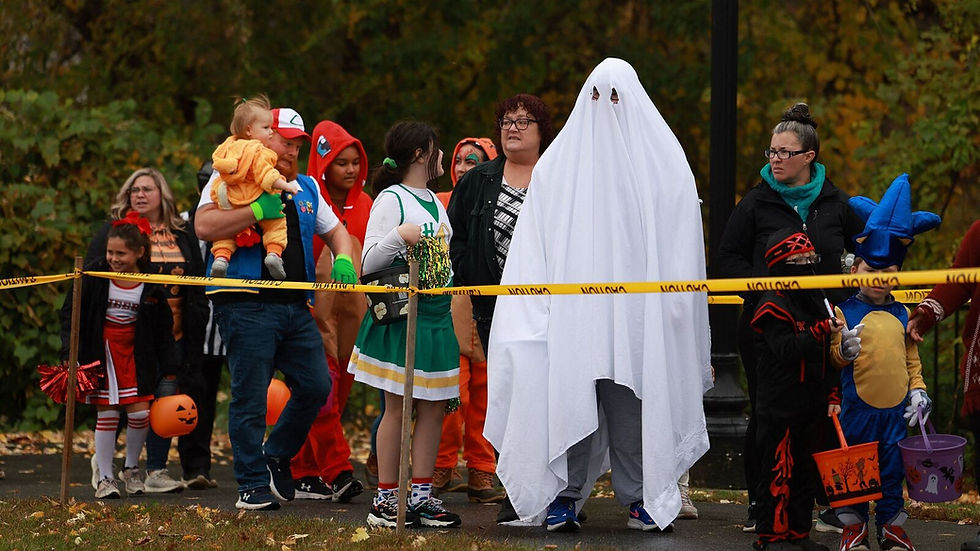
Early American costumes were often homemade and centered on ghosts, witches, monsters, masks, and other spooky imagery. Later, commercially produced costumes and popular culture expanded the possibilities dramatically.
Halloween was becoming not only a seasonal tradition but also a form of creative self-expression.
What the Origins of Halloween in America Tell Us Today
The most important lesson from Halloween history America is that the holiday was never static. It changed every time it entered a new community.
Ancient seasonal traditions contributed the atmosphere of mystery. Christian observances influenced the calendar. Irish and Scottish immigrants brought customs across the Atlantic. American communities added harvest gatherings, parties, pranks, costumes, and eventually trick-or-treating. Consumer culture later introduced mass-produced costumes, candy, decorations, and an enormous Halloween marketplace.
Today, Halloween is one of America's most recognizable holidays, but its meaning can still be deeply personal.
Halloween Is Still Evolving
Modern Americans may celebrate with pumpkin carving, horror movies, neighborhood trick-or-treating, costume parties, haunted attractions, DIY decorations, family traditions, or simple seasonal gatherings.
The Library of Congress describes Halloween as one of the most popular holidays in contemporary America, with a rich record of folk customs, art, literature, and popular culture.
In 2026, Halloween continues to expand beyond October 31, with decorating, crafting, movie nights, parties, and family traditions becoming part of the wider October experience.
Halloween Apparel Carries the Tradition Forward
You do not need an elaborate costume to participate in that history. A vintage Halloween T-shirt, spooky graphic tee, pumpkin shirt, retro Halloween design, or family matching shirt can be a simple way to bring the holiday into everyday October life.
Explore our Halloween graphic shirts, retro spooky apparel, pumpkin-themed T-shirts, funny Halloween tees, and seasonal fall designs to find something that fits your own celebration. Whether you're carving pumpkins, hosting a movie night, attending a Halloween party, or simply enjoying the season, a comfortable graphic shirt can become part of the memory.
The origins of Halloween in America are not really the story of one tradition arriving intact. They are the story of traditions meeting, changing, and becoming something new. From ancient seasonal customs and Irish immigration to neighborhood parties and modern Halloween fashion, every generation has
added another layer. That may be the most American part of Halloween itself: it keeps changing, yet somehow still feels familiar every October.
Stay tuned for more updates:


Comments